Beyond Blame and Prayer: Growing Africa’s 2% of DoersBy Dr. Betty Anyanwu-Akeredolu

OPINION
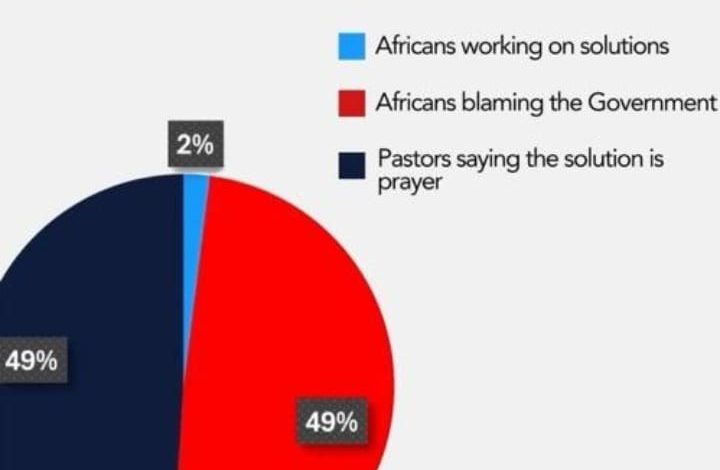
I just came across this post by @The_Jeffersonn on a pie chart making rounds on X social media titled “Poverty in Africa.” The data, though simplistic and likely symbolic, left a profound impression:
49% blame the government,
49% rely on prayer as the solution,
And only 2% are working on actual solutions.
Whether this chart was born from a survey or satire, it speaks volumes about the prevailing mindset in many African societies. It reflects not just poverty of resources, but of agency, critical thinking, and collective responsibility. If taken seriously, it offers an invitation—a challenge—for introspection, reorientation, and decisive action.
The Blame Culture (49%)
Governments in many African countries have undeniably contributed to the continent’s poverty through corruption, policy inconsistency, and weak institutions. But to place all the blame solely at the feet of leadership is to underestimate the power of the people—men and women alike.
Blaming the government without civic engagement or grassroots effort creates a passive citizenry. It shifts people into a waiting mode—waiting for politicians to fix things, waiting for development to trickle down, waiting for someone else to care. This passivity often ignores half the population—women—who are sidelined by systemic barriers yet hold immense potential to drive change.
The solution? Citizens must go beyond protests and hashtags. We need participatory governance—where people vote with wisdom, hold leaders accountable, demand transparency, and organize to develop their communities. This includes empowering women to take leadership roles, challenge policies, and build solutions. We must educate ourselves on policies, engage in dialogue, and take local action where national leadership fails.
The Pulpit Dependency (49%)
Religion is deeply embedded in African identity. For many, faith offers hope in difficult times. However, the over-reliance on prayer as the only strategy for overcoming poverty is problematic. Faith without works is still dead.
When pastors emphasize divine intervention while ignoring real-world tools like education, technology, and entrepreneurship, they risk paralyzing progress. Hope becomes an opiate. People—especially women—are told to wait for miracles instead of creating change, often reinforced by religious interpretations that uphold patriarchal norms and limit female agency.
What’s needed? A theology that uplifts dignity through labor, encourages economic empowerment, and supports practical growth for all. Churches and mosques should become not just places of worship, but hubs for vocational training, financial literacy, and youth mentorship—spaces where women are equipped to lead and innovate. Religion should inspire action—not inertia—across genders.
The Neglected 50%: Women as Catalysts for the 2%
Africa has for far too long neglected 50% of its population—women—largely due to patriarchal tendencies with deep roots in culture and religion. These entrenched systems have confined women to subordinate roles, limiting access to education, land ownership, capital, and decision-making. This exclusion isn’t just a moral failing; it’s a developmental disaster. Women are not just half the population—they are half the potential, half the creativity, and half the solutions.
Patriarchy, woven into traditions and religious teachings, often dictates that women prioritize domestic roles over leadership, innovation, or entrepreneurship. Cultural norms discourage girls from pursuing STEM fields, while religious doctrines sometimes misinterpret sacred texts to justify inequality. The result? A continent that cripples its own progress by sidelining the very people who birth, nurture, and sustain its communities.
Yet, women are already proving their power within the 2%. From female farmers adopting sustainable practices to women in tech building apps for financial inclusion, they are breaking barriers. Organizations like BEMORE Empowered Girls Foundation show how equipping girls with skills in STEM, leadership, and advocacy can transform communities. Women, when given tools and opportunities, multiply impact—investing in families, education, and local economies at higher rates than men, studies show.
To grow the 2%, we must unleash the 50%. This means dismantling patriarchal structures—challenging cultural taboos, reinterpreting religious teachings for equality, and ensuring women have seats at every table, from village councils to corporate boards. It means funding women-led startups, mentoring girls in science and technology, and amplifying female voices in policy and innovation. Women aren’t just part of the solution; they are essential to scaling it.
The 2% Working on Solutions
The most alarming statistic in that pie chart is the 2%. If accurate—even symbolically—it means the vast majority are spectators in their own development story. It signals a population disempowered by systems, discouraged by setbacks, or distracted by false hopes—compounded by the exclusion of women from full participation.
But this 2%—the entrepreneurs, social innovators, educators, community leaders, and advocates, many of them including women are the ones holding the key to Africa’s future. They are the quiet builders, changemakers, and reformers. They don’t wait for things to get better. They get to work.
Our challenge now is to grow this 2%.
We must equip the youth—especially girls—with practical skills and digital tools. We must fund local solutions that emerge from the grassroots, including women-led initiatives. We must celebrate innovation, reward resilience, and tell the stories of Africans- men and women—solving African problems.
This also means moving from dependency to dignity. Aid has its place, but self-determination must be the goal. Communities, with women at the forefront, must own their development and chart their course with data, discipline, and vision.
A New Path Forward
Africa’s transformation won’t come through blame or only through prayer. It will come when we stop pointing fingers and start lifting hands—hands of men and women that build, create, collaborate, and innovate.
Here’s what we must do:
Educate the mind – Prioritize critical thinking and technical skills in our schools, especially for girls in STEM.
Empower the youth – Provide access to tools, mentorship, and capital, with targeted support for young women.
Strengthen institutions – From local cooperatives to national agencies, ensuring gender equity in leadership.
Integrate faith with action – Let our prayers fuel purpose and productivity, challenging patriarchal interpretations.
Tell better stories – Celebrate the doers, especially women, and make role models of builders.
The time has come to scale that 2%. From 2% to 20%, and eventually a tipping point where problem-solving, led by women and men alike, becomes the new culture.
Final Word
Poverty is not just a condition—it’s a consequence of choices made at all levels: political, spiritual, and personal. Africa’s potential is real, but it will not be realized by spectators or by sidelining half its people. Only doers—women and men—will lead the charge.
Let’s move past blame. Let prayer empower us. Let’s unleash the 50% to grow the 2%. And let’s get to work.
Signed:
Dr. Betty Anyanwu-Akeredolu
akeredolubetty@gmail.com
Founder/CEO, BEMORE Empowered Girls Foundation (bemoregirlsnaija.org)
Founder/CEO, Betty Anyanwu-Akeredolu Foundation, BAAF (baafonline.com)
Advocate for Women in STEM | Aquaculture Entrepreneur & Researcher| Rural Health Strategist] Birth Registration Advocate